214 specific skills

SAT Math practice questions

Answer one problem at a time. Read the worked steps and track each skill from Learning through Sharp.

Start 7 days free

No credit card. The trial ends on its own.

Question 1 of 5Medium · Data Analysis

A list of positive integers has a sum of . What is the greatest possible value in the list?

See the full workspace

The whole product on one screen.

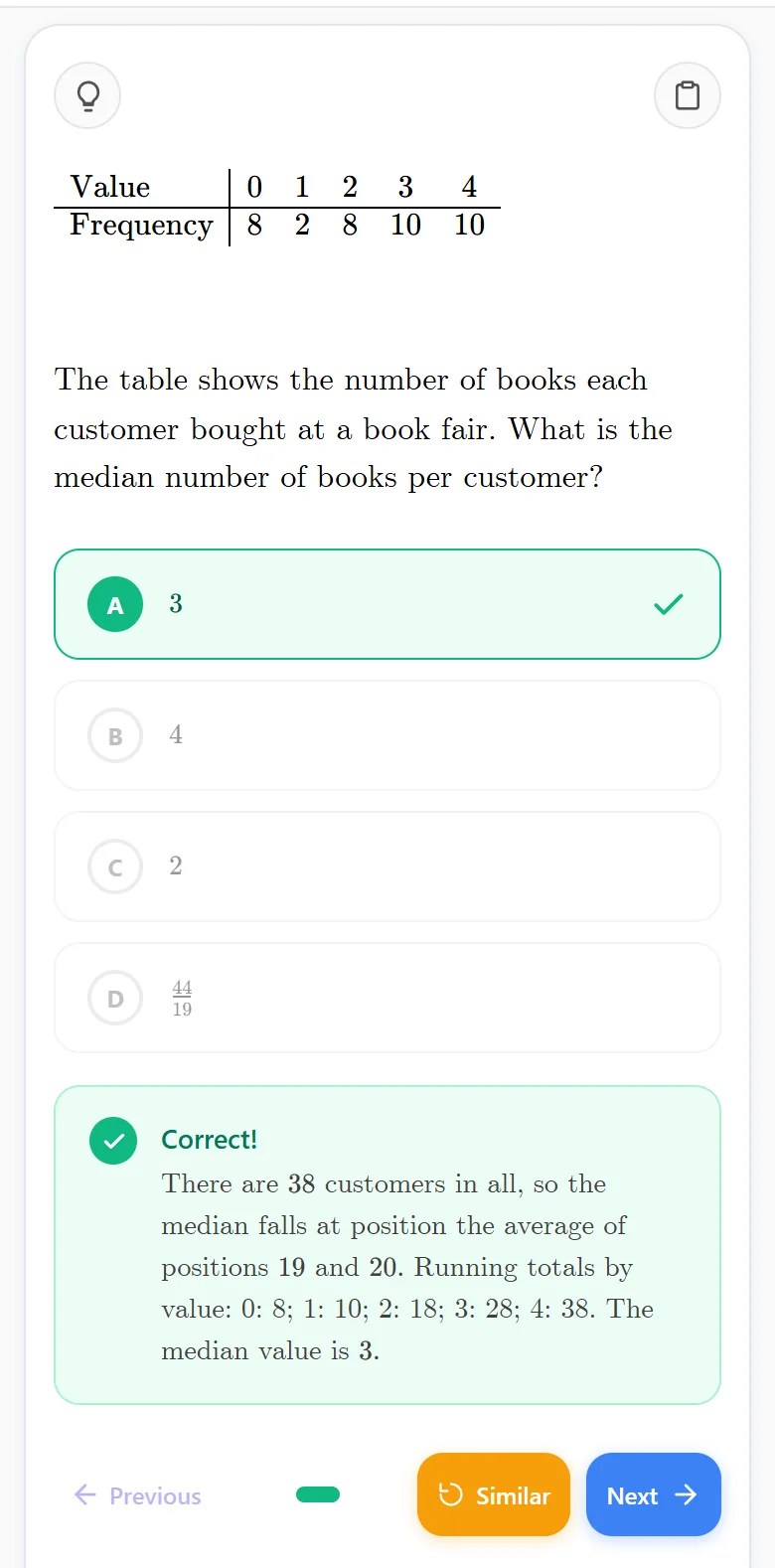
A Lodera SAT Math practice question beside the four skill domains123
1Your topics2One question3Worked steps

Course coverage

Topics in the SAT Math bank

Lodera tracks exact skills and gives each one focused practice.

Algebra34 skills
  1. From the sum of a run to a named member
  2. Two-step linear equations
  3. From one member of a run to its sum
  4. Equations with distribution on both sides
  5. Equations with fraction coefficients
  6. Relations between consecutive integers
  7. Equations with no solution or infinitely many
  8. Evaluate a scaled expression from an equation
  9. Rearranging a formula for a variable
  10. Rearranging when the target variable appears twice
  11. Chained substitution through an intermediate variable
  12. Solving inequalities with a sign flip
  13. Extreme values under a sum constraint
  14. Absolute value equations: the two cases
  15. Absolute value equations with no solution
  16. Absolute value inequalities as intervals
  17. Counting integer solutions of an absolute value inequality
  18. Minimum value of an absolute value expression
  19. Reading slope from a graph
  20. When a graphed line reaches a value
  21. Comparing slopes of two graphed lines
  22. Parallel and perpendicular slopes
  23. Intercepts of a translated line
  24. Points on a line from a point and a slope
  25. Line equations and intercepts from a point and a slope
  26. Solving systems by elimination
  27. How many solutions a system has
  28. Parameters that make a system special
  29. Solving systems by substitution
  30. Combining equations to hit a target expression
  31. Verifying a solution of a system
  32. Translating a scenario into a system
  33. Value-and-quantity word problems
  34. Sum-and-difference word problems
Advanced Math67 skills
  1. Distribute and collect like terms
  2. Interpreting part of an expression in context
  3. Equivalent forms by factoring out a common factor
  4. Percent multipliers in expressions
  5. Matching coefficients in an identity
  6. Expression values from a stated ratio or difference
  7. Adding and subtracting polynomials
  8. Multiplying a polynomial by a monomial
  9. Multiplying binomials
  10. Special products: squares of binomials
  11. Dividing a polynomial by a monomial
  12. Finding one coefficient of an expanded product
  13. Factoring monic trinomials
  14. Factoring nonmonic trinomials
  15. Factoring a difference of squares
  16. Solving quadratics by factoring
  17. Solving by factoring out a common factor
  18. Solving with the square-root method
  19. The quadratic formula
  20. Completing the square to vertex form
  21. Building a quadratic from its zeros
  22. Recognizing when a trinomial does not factor
  23. Sum and product of roots from factored form
  24. Sum and product of roots from coefficients
  25. Axis of symmetry from the x-intercepts
  26. Max and min from a vertex-form model
  27. Choosing a parameter for exactly one solution
  28. How many times a line meets a curve
  29. Equivalent forms that reveal a graph feature
  30. Evaluating a function at a number
  31. Evaluating a function at an expression
  32. Function values from a table
  33. Function notation in context
  34. Why f(a+b) is not f(a) + f(b)
  35. Composition from a table
  36. Composition from rules
  37. Solving f(x) = c
  38. Domains with radicals
  39. Simplifying rational expressions
  40. Combining rational expressions
  41. Excluded values of rational expressions
  42. Building a rational function to a spec
  43. Rational equations with an excluded root
  44. Evaluating with integer exponents
  45. Simplest radical form
  46. Powers of products
  47. Adding and multiplying radicals
  48. Quotients with positive exponents
  49. Evaluating rational exponents
  50. How powers scale when the base is scaled
  51. Radical and rational-exponent notation
  52. Collapsing sums of identical powers
  53. Solving square-root equations
  54. Extraneous solutions from squaring
  55. Solving nth-root and power equations
  56. Squares of binomials in equations
  57. Building an exponential model
  58. Percent change from the base of a model
  59. Evaluating an exponential model
  60. The meaning of the initial value
  61. Model values before the starting time
  62. Identifying a decay model
  63. Doubling and halving periods
  64. Linear versus exponential change
  65. Solving by matching bases
  66. Growth over different time windows
  67. When exponential growth overtakes linear
Problem-Solving and Data Analysis63 skills
  1. Solve ratio and proportion problems
  2. Unit rates and unit conversion
  3. Rates in real-world contexts
  4. Chained multi-step unit conversions
  5. Convert between part-to-part and part-to-whole ratios
  6. Scale a ratio or recipe to a new total
  7. Compare unit rates to identify the better value
  8. Identify a proportional relationship from a table or equation
  9. Scale drawings and map distances
  10. Mixture and concentration ratios
  11. Percent of a quantity and reverse percent
  12. Percent increase and decrease
  13. Successive percent changes
  14. Tax, tip, discount, and commission scenarios
  15. Percent error between an estimate and an actual value
  16. Construct a linear model from a stated rate and starting value
  17. Construct a linear model from two data points or a table
  18. Interpret the y-intercept of a linear model in context
  19. Interpret a solution point of a linear equation in context
  20. Write or interpret a linear inequality constraint from a scenario
  21. Select the equation that models a verbal description
  22. Use a linear model to predict or extrapolate a value
  23. Decide whether a scenario is modeled by a linear relationship
  24. Determine a realistic domain or range restriction for a linear model
  25. Total-cost and plan-comparison scenarios
  26. Mean, median, mode, and range
  27. Effect of changing a data point on mean and median
  28. Weighted averages and combined means
  29. Range and spread comparisons
  30. Distribution shape — symmetric vs skewed
  31. Mean vs. median ordering from skew
  32. Comparing spread between distributions
  33. Identifying outliers in a distribution
  34. Comparing center and spread together
  35. Effect of an outlier on spread
  36. Reading bar and line graphs
  37. Dot plots — reading and center
  38. Histograms — frequencies and median interval
  39. Box plots — median, quartiles, and IQR
  40. Frequency and relative frequency tables
  41. Two-way tables — counts and percents
  42. Association direction and strength
  43. Interpolating with a line of best fit
  44. Extrapolating with a line of best fit
  45. Slope of a best-fit line in context
  46. Y-intercept of a best-fit line in context
  47. Point that deviates most from the line
  48. Choosing a model from scatter shape
  49. Points above vs. below the line
  50. Probability from counts and frequencies
  51. Two-way tables and conditional frequencies
  52. Complement rule for probability
  53. Compound events described with "or"/"and"
  54. Conditional probability stated verbally
  55. Expected counts from a probability
  56. Equally likely outcomes in a sample space
  57. Interpreting margin of error
  58. Sample size and margin of error
  59. Scope of generalization from a sample
  60. Random assignment and causation
  61. Identifying a biased sampling method
  62. Evaluating whether a claim is supported
  63. Correlation vs. causation
Geometry and Trigonometry50 skills
  1. Triangle angle sum
  2. Parallel lines cut by a transversal
  3. Exterior angles and isosceles triangles
  4. Similar triangles and proportional sides
  5. Vertical, supplementary, and complementary angles
  6. Triangle congruence criteria
  7. Corresponding parts of congruent triangles
  8. Deciding triangle similarity by AA
  9. Angle chasing across intersecting lines
  10. Triangle inequality for possible side lengths
  11. Interior and exterior angle sums of polygons
  12. Properties of parallelograms
  13. Properties of rectangles and rhombi
  14. Properties of trapezoids
  15. Solving for an unknown using quadrilateral properties
  16. Regular polygon angle computations
  17. Areas of rectangles, triangles, and composite figures
  18. Circle area and circumference
  19. Volumes of prisms and cylinders
  20. Volumes of cones, spheres, and pyramids
  21. Recover a dimension from a known area or volume
  22. How scaling dimensions changes area and volume
  23. Perimeter of polygons and composite figures
  24. Area of trapezoids and other quadrilaterals
  25. Shaded-region area by subtraction
  26. Surface area of prisms and cylinders
  27. Area and volume in applied contexts
  28. Pythagorean theorem computations
  29. Special right triangles
  30. Trig ratios from side lengths
  31. Solve for a side using a trig ratio
  32. Sine and cosine of complementary angles
  33. Angle of elevation and depression word problems
  34. Pythagorean converse to classify a triangle
  35. Three-dimensional diagonals via the Pythagorean theorem
  36. Trig ratios preserved across similar right triangles
  37. Find one trig ratio from another
  38. Distance between two points
  39. Midpoint of a segment
  40. Perimeter or area of a figure from vertex coordinates
  41. Finding a missing vertex coordinate
  42. Point that partitions a segment in a given ratio
  43. Read center and radius from a circle equation
  44. Complete the square to find a circle's center and radius
  45. Points on a circle
  46. Arc length and sector area
  47. Central angles and radian-degree conversion
  48. Inscribed angle and central angle relationship
  49. Tangent line perpendicular to a radius
  50. Chord and diameter relationships

What is in this bank

Focused practice by SAT domain.

Lodera questions are original practice written to prepare you for the exam. They practise the same skills at a similar level, but they are not copies of real SAT or AP exam questions.

Graphs appear in Algebra, Advanced Math, and Data Analysis. Tables appear in those same domains.

Take full tests in Bluebook.

Bluebook has College Board's official full-length digital SAT practice tests.

Lodera has no full-length tests, lessons, or free-response questions. Use it for skill-by-skill practice after instruction.

One course starts at $79.99 a year.

That is $6.67 a month, billed yearly. Test in a few weeks? The monthly plan is $12.99 and you can cancel anytime.

Start 7 days free

Questions from parents

Can I see my student's progress?

There is no separate parent view yet. Your student can show you their topic list, which shows a level for every skill.

Start with no credit card

Find the math skills you still need.

Start 7 days free